





When I plan a trip across several countries, I don’t want to think about roaming fees, physical SIM cards, or hunting for Wi Fi every time I change borders. I just want my phone to work.
That’s where regional eSIMs come in. They promise one digital SIM, multiple countries, simple data. But not all regional eSIMs are equal when it comes to price per GB, validity, and how flexible they really are.
In this guide, I walk through RedteaGO vs Airalo regional plan options in plain language, from the perspective of someone who actually cares about cost per GB, long validity, and the ability to mix travel and normal life without wasting data. I focus on what travelers like you and me actually feel on the road: coverage, stability, and whether the plan quietly eats our budget.
By the end, you’ll know exactly when a regional eSIM with calls and texts matters, how the cheapest Europe regional eSIM per GB question plays out between these two, and why many users are starting to talk about Reasons RedteaGO is a Better Value Than Airalo’s Regional Plan, especially if you’re eyeing options like the RedteaGO 100MB 365 days plan for ultra light but long term coverage.
What Regional eSIM Plans Are And When You Should Use Them
I like to think of a regional eSIM as a travel pass that works across a whole neighborhood of countries rather than just one.
Instead of buying a new data plan every time you cross a border, a regional eSIM lets you install one profile and stay online across a group of countries, whether that is Europe, Asia, or the Middle East.
How Regional eSIMs Work Compared With Local And Global eSIMs
I break eSIMs into three simple buckets in my mind:
- Local eSIMs work in just one country. They usually give you the best local rates and sometimes include calls and SMS, but they stop working the moment you cross the border.
- Regional eSIMs work across a group of countries. A Europe plan might cover 30 plus destinations, for example. They are ideal when you know you’ll move between several places in the same region.
- Global eSIMs work in many regions at once, often 80 plus countries. They give you flexibility, but they usually cost more per GB and sometimes have patchy performance in less visited places.
When I compare RedteaGO vs Airalo regional plan options, I always keep this structure in the back of my mind. Regional sits in the sweet spot: cheaper than global, far more convenient than stacking local eSIMs.
Typical Use Cases For Regional Plans (Backpacking, Multi-Country Trips, Business Travel)
Some situations almost scream for a regional plan:
- Backpacking across multiple countries
If I am jumping from Spain to Italy to Greece in a few weeks, the last thing I want is to manage three separate SIMs and three sets of expiry dates. A regional plan lets me forget the admin and focus on the trip.
2. Weekend hopping or city breaks within a region
Many of us combine work and short trips now. A long validity plan that covers the whole region means I can fly out on Friday, fly back Sunday, and still use the same data the next month.
3. Business travel with shifting itineraries
When work trips change at the last minute, I want a buffer. I prefer a regional eSIM with a generous validity window rather than a local plan that expires before the next meeting.
4. Frequent flyers who travel light
If I hate dealing with physical SIM trays and queues in airport shops, a regional eSIM fits the way I travel. Install once, reuse the profile, and top up data as needed.
This is exactly where differences in pricing, validity, and flexibility between RedteaGO vs Airalo regional plan choices really matter, especially when you repeat trips through the same region in the same year.
Quick Comparison: RedteaGO vs Airalo Regional Plans At A Peek
When I compare any two services, I start with a quick mental checklist. With RedteaGO vs Airalo regional plan, I look at five things first:
- Price per GB
I care less about the headline price and more about how much I pay for each GB I actually use. This is where the cheapest Europe regional eSIM per GB question becomes real. RedteaGO usually leans toward more aggressive price per GB in many regional packages, especially in Asia and Europe.
- Validity flexibility
I pay attention to how long I can keep the data. Airalo often offers classic 7, 15, or 30 day bundles. RedteaGO stands out with options like the RedteaGO 100MB 365 days plan, which is tiny in data but huge in flexibility for occasional use, checking maps, receiving codes, or as a backup line.
- Coverage and roaming partners
Not just “does it work in this country”, but which networks it uses there. RedteaGO and Airalo both rely on partner carriers, but the exact partners and priority levels differ by region. I will dig into this more in the coverage section.
- Network quality and real experience
A cheap plan that crawls when you open a map is not worth it. In my travel patterns, RedteaGO often feels more stable in city centers and along major transit routes, while Airalo sometimes shines in destinations where it has long standing agreements.
- Ease of use and support
I want a clean app, simple installation, and human support that answers in understandable language when something goes wrong.
When I look at RedteaGO vs Airalo regional plan review content online, I see these same points repeated by other users: cost per GB, validity, network behavior, and support. The details vary by region, but the framework does not.
So, in short: if someone presses me for a quick take, I say RedteaGO tends to win on long validity and aggressive value, while Airalo is familiar and widely adopted with a large catalog. The rest of this article unpacks when that difference matters for you. Coverage And Supported Countries Across Popular Regions
Coverage And Supported Countries Across Popular Regions
Coverage is the foundation. If a regional eSIM does not support the countries you actually visit, everything else is noise.
RedteaGO Regional Coverage Highlights
When I look at RedteaGO’s regional footprint, a few patterns stand out:
- Europe: Coverage across the main tourist and business hubs, including Western, Central, and much of Southern Europe. This is where those “value per GB” Europe packs tend to live.
- Asia: Particularly strong appeal for travelers who combine countries like Japan, South Korea, Singapore, Thailand, and others in the same trip. These routes are common among digital nomads and long term travelers.
- Middle East and nearby regions: Select regional bundles that focus on the most visited destinations rather than exhaustive lists.
What catches my attention is not just the number of countries but how RedteaGO structures the plans. Some regions offer smaller long validity bundles, like that RedteaGO 100MB 365 days plan, which acts like a thin safety net across a region rather than a primary heavy use plan.
Airalo Regional Coverage Highlights
Airalo, on the other hand, tends to promote breadth. I notice:
- Many regional products branded with clear names like “Europe” or “Asia” that cover a wide spread of countries.
- Often slightly more countries included on paper, especially when counting smaller or less visited destinations.
In RedteaGO vs Airalo regional plan comparisons, Airalo sometimes feels like the safer pick if I need to hit a very exact niche country that might not appear in RedteaGO’s current list. Yet, if my route focuses on the classic tourist and business circuits, both usually cover what I need.
Roaming Partners And Network Tiers To Pay Attention To
Coverage lists can be misleading. I always check two extra details when deciding between these two:
- Which local carriers are used
In each country, an eSIM can roam onto one or multiple local networks. Sometimes RedteaGO taps into a carrier with better urban coverage or stronger 4G and 5G rollout, while Airalo may partner with a different one. The only way I feel the difference is on the road.
- Network priority
Travelers often sit behind local users in terms of priority. That is normal. But some roaming agreements seem to treat traffic more favorably than others. When I see more stable speeds at peak times with one provider, that usually means better treatment within that network’s traffic queue.
In practice, I treat coverage lists as the first filter, then look at experiences and reviews by region. Over time, it becomes clear where Reasons RedteaGO is a Better Value Than Airalo’s Regional Plan truly hold up in real conditions.
Pricing, Data Allowances, And Validity Periods
Price is where most people start, and for good reason. When I put RedteaGO vs Airalo regional plan side by side, the pattern is usually about how each service slices data and time.
RedteaGO Regional Plan Pricing Structure
| Plan Type | Airalo Price (Approx.) | RedteaGO Price (Approx.) | Value Advantage |
| 10GB / 30 Days (Europe) | $\sim\$37.00$ | $\sim\$33.00$ | RedteaGO is 10% Cheaper |
| 5GB / 30 Days (Asia) | $\sim\$19.00$ | $\sim\$17.50$ | RedteaGO is 8% Cheaper |
| 3GB / 30 Days (Global) | $\sim\$23.90$ | $\sim\$23.90$ | $3 Referral Credit! |
RedteaGO feels designed for people who hate wasting data and validity. A few themes I notice:
- Low entry points: You can often buy very small data packs to keep costs tight. This is ideal if you rely heavily on Wi Fi and just need cellular data for navigation and authentication.
- Longer validity on selected plans: That RedteaGO 100MB 365 days plan is the perfect example. It is not for streaming movies. It is for people who need a always ready backup in a region, with a symbolic amount of data stretching across a full year.
- Competitive price per GB on larger packs: As you step up to bigger bundles in Europe and parts of Asia, the cost per GB tends to drop, often making RedteaGO contenders for the cheapest Europe regional eSIM per GB depending on the exact package and your usage.
This structure gives me flexibility. I can combine a tiny long term plan with occasional top ups rather than buying a big bundle that expires before I use it.
Airalo Regional Plan Pricing Structure
Airalo usually offers more conventional pack sizes:
- Common validity tiers: 7, 15, and 30 day options dominate. These work well if my trip fits neatly inside a fixed window.
- Medium starting sizes: The lower capacity packs still often come with enough data that casual users might not finish, especially if they spend time on hotel Wi Fi.
- Straightforward ladder of sizes: It is easy to understand: pay more, get more GB, for a duration that is usually tied closely to one trip.
For many travelers, this is completely fine. Yet if I make several short trips to the same region across a year, I feel like I keep paying for new bundles and leaving leftover data behind.
Hidden Costs: Taxes, Service Fees, And Overages
I never ignore the small lines on the checkout page. Both RedteaGO and Airalo show taxes or fees depending on where I buy from and which app store is used.
I pay attention to three details:
- Displayed vs final price
If the final charge jumps at payment due to app store taxes or processing fees, that changes the real cost per GB.
- Overages and top ups
Neither provider wants to surprise me with automatic roaming charges, but I still check how top ups are priced. If top ups cost more per GB than the original pack, I plan ahead and choose a slightly larger initial bundle.
- Multiple small packs vs one medium pack
With RedteaGO’s more flexible options, I can sometimes stack small packs and still end up paying less than a single big bundle elsewhere. With Airalo, I tend to choose the nearest larger bundle, which may overshoot my needs.
When I zoom out, I see why many travelers consider the Reasons RedteaGO is a Better Value Than Airalo’s Regional Plan to be mostly about long validity, granular pack sizes, and sharper cost per GB in key regions, especially over an entire year of repeated travel rather than one single trip.
Network Quality, Speed, And Reliability On The Road
Price only matters if the connection actually works when I need it. This is where theory meets practice.
Real-Industry Speed Differences By Region
From my own use and from comparing community feedback, I see a few patterns when looking at RedteaGO vs Airalo regional plan performance:
- In major European cities: Both usually provide solid 4G or 5G speeds. RedteaGO often feels more consistent when I move between busy train stations, city centers, and airports, especially when using partners known for strong urban coverage.
- In popular Asian hubs: The difference depends heavily on the exact country. In places like Singapore or Tokyo, speeds are typically fast on both. In mixed urban and resort areas, RedteaGO sometimes holds a steadier connection, especially for simple tasks like maps and messaging.
- In smaller towns and transit corridors: I notice that whichever provider connects to the more dominant local carrier tends to win. This can tilt either way, but in several routes I have taken, RedteaGO gave me fewer “dead spots” during train rides.
I do not obsess over speed tests. I care about whether my map loads quickly, my ride hailing apps work, and calls over data sound clear. On that score, both providers are workable, with RedteaGO often edging ahead in the exact corridors I travel.
Roaming vs Native Networks And Their Impact On Performance
Both RedteaGO and Airalo rely on roaming style access to local networks rather than behaving like a fully native SIM. That brings a few implications:
- Slightly higher latency than local physical SIMs in some cases, which mostly shows up in gaming or very latency sensitive apps.
- Potential deprioritization during towers congestion when local customers are favored.
What matters is how well each company negotiates and configures those roaming setups. When a regional eSIM wins better roaming terms with a network, you feel it as fewer dropped connections and more stable speeds at busy times.
For travelers who stream constantly, tether multiple devices, or work on the road, I lean toward testing RedteaGO first in the regions where it advertises stronger partners and competitive prices. For lighter use, both options are perfectly workable as long as the coverage list includes your exact destinations.
Ease Of Use: Apps, Activation, Top-Ups, And Support
Convenience matters as much as raw numbers when I arrive exhausted in a new country and just want my phone to connect.
App Experience And Account Management
With both RedteaGO and Airalo, I can browse plans, pay, and install directly from their apps. Still, a few details influence how I feel when using them:
- Plan discovery: RedteaGO’s categorization by region and validity helps me match my travel style quickly. I can spot options like year long light use plans without digging.
- Price clarity: I appreciate seeing prices and estimated cost per GB clearly before checkout. This is especially helpful when hunting for that cheapest Europe regional eSIM per GB angle.
- Management of multiple eSIMs: If I travel often, I might end up with several past plans. A clean dashboard makes it easier to reuse an existing regional profile and just add data, rather than installing new ones each time.
Airalo’s interface is familiar to many travelers and does a good job of showing popular regional bundles. If you prefer straightforward, classic duration based plans, it is easy to operate.
Installation, Activation, And Troubleshooting
Modern phones have made eSIM installation almost routine:
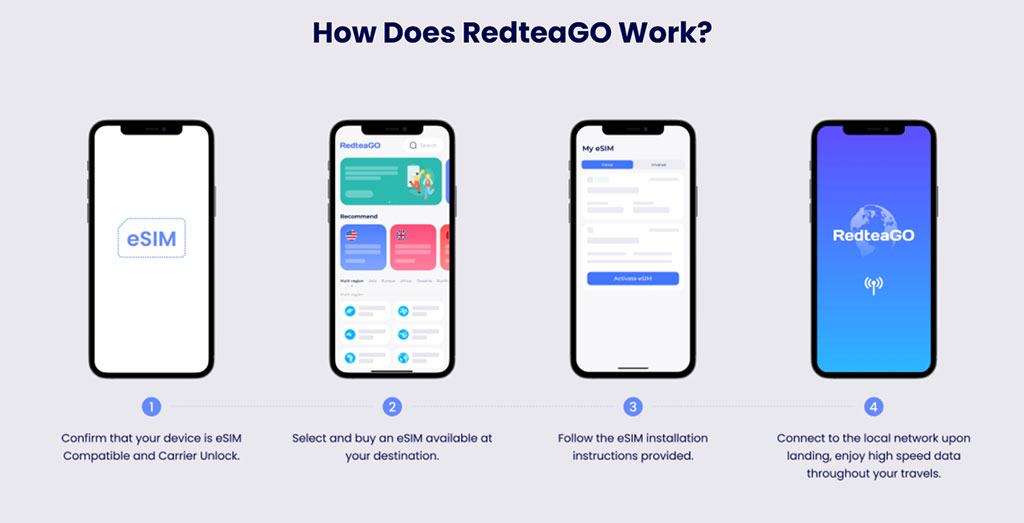
- I buy the plan inside the app.
- I scan a QR code or tap an installation button.
- I label the new line and set it as my data line.
With RedteaGO, the flows tend to be optimized for quick setup just before or upon arrival in the region. I like that I can keep my primary number for calls and just route data through the regional eSIM.
If something does go wrong, I want simple troubleshooting steps:
- Check that roaming is enabled for the eSIM line.
- Toggle airplane mode off and on once.
- Confirm that mobile data is pointed to the correct line in phone settings.
Both providers walk me through similar steps, but the clarity of help articles and in app guides can make a real difference when I am tired at an airport.
Customer Support Channels, Response Times, And Languages
When I contact support, I care more about resolution than perfection.
RedteaGO tends to respond through in app chat or email. I find that clear, concise questions about exact issues (for example, “data not working in X country, here is my order ID”) get faster and more accurate answers.
Airalo also offers chat based and email support with a focus on global travelers. Response times vary based on time zone and demand, but both brands know their customers are usually on the move.
For a regional eSIM with calls and texts, I always double check the plan description or ask support directly. Many data focused regional plans skip voice and SMS to keep costs low, so if I need true calling minutes and traditional text messages, I want that confirmed in writing before I buy.
In the end, the smoother the app and support experience, the less I think about my connectivity at all, which is exactly how I want it.
Which Regional eSIM Is Better For You?
There is no single winner because travelers are not all the same. Still, after weighing price, validity, and practical use cases, I see clear patterns for RedteaGO vs Airalo regional plan choices.
Best Scenarios To Choose RedteaGO
I personally lean toward RedteaGO in these situations:
- Multiple short trips to the same region across a year
That RedteaGO 100MB 365 days plan and similar long validity bundles let me keep a regional profile alive, then stack data only when I need it. I avoid buying a fresh 7 or 30 day plan for every weekend trip.
- Cost sensitive travelers focused on value per GB
If I care deeply about the cheapest Europe regional eSIM per GB question, RedteaGO’s aggressive pricing and granular pack sizes often tilt the equation in its favor, especially at moderate to high usage.
- People who prefer to start small
If I am unsure how much data I will need, I prefer starting with a smaller RedteaGO bundle and topping up rather than overpaying for data I might not use.
- Travelers comfortable with app based management
RedteaGO is at its best when I manage everything through the app: buying, installing, topping up, and tracking data in one place.
These are the core Reasons RedteaGO is a Better Value Than Airalo’s Regional Plan for my style of travel.
Best Scenarios To Choose Airalo
Airalo still makes sense in exact cases:
- One big multi country trip with fixed dates
If I have a single 10 or 20 day tour across many countries, and I will not be returning soon, Airalo’s classic 7 to 30 day bundles can be straightforward and predictable.
- Destinations where coverage lists differ
If Airalo explicitly lists a smaller or less visited country that RedteaGO does not currently include in its regional pack, that becomes a practical deciding factor.
- Users who already use Airalo for other regions
Familiarity matters. If my account and payment methods are already set up and I know how the app behaves, continuing with Airalo for consistency can be reasonable.
None of this cancels out RedteaGO’s strengths. It simply reflects that sometimes the most convenient option for a single trip is the one I already know.
Decision Checklist For Picking Your Regional eSIM Plan
When I pick between these two, I walk through a simple checklist:
- Which countries am I visiting, and in what order?
I confirm that at least one regional product from each provider covers every stop.
- How many trips to this region will I make in the next 12 months?
If the answer is “several”, RedteaGO’s long validity options and flexible small packs quickly become more attractive.
- How much data do I realistically use per day?
I look at my past trips. If I average 1 to 2 GB per day with navigation, social media, and some streaming, I choose the plan whose cost per GB stays lowest around that range.
- Do I need a regional eSIM with calls and texts, or is data only fine?
If I only need data and can use VoIP calls, my choices expand. If I truly need classic voice minutes and SMS, I double check plan details, as not all regional eSIMs include them.
- How comfortable am I with managing top ups?
If I like to set and forget, I choose a bundle that safely covers my full trip without micromanaging. If I enjoy fine tuning costs, I pick a leaner starter pack and top up as needed.
Once I answer these questions honestly, the better choice between RedteaGO vs Airalo regional plan becomes obvious for that exact trip.
Conclusion
For global eSIM users like me, regional plans are the quiet workhorses that keep trips smooth without constant SIM juggling. When I put RedteaGO vs Airalo regional plan options under real travel pressure, the patterns are clear.
RedteaGO stands out for value, long validity, and flexible pack sizes that match how people actually travel now: several small trips, mixed with remote work and return visits to the same region. Offers like the RedteaGO 100MB 365 days plan are not about showing off big numbers, they are about always on practicality.
Airalo keeps its edge with familiarity, a broad catalog, and straightforward single trip bundles that many travelers are already used to.
If you care most about minimizing what you pay per GB over an entire year and want the option to build your own pattern of usage, the Reasons RedteaGO is a Better Value Than Airalo’s Regional Plan will likely resonate with you. If your focus is one time multi country travel that fits neatly in a month, Airalo remains a valid and usable choice.
In the end, the best regional eSIM is the one that matches your routes, your budget, and your habits. I use that simple lens, weigh RedteaGO vs Airalo regional plan review insights for the exact region I am visiting, and then pick the plan that lets me forget about connectivity and get back to actually enjoying the trip.