Picking a travel eSIM can feel like guesswork. Prices look similar, coverage maps are confusing, and every provider claims to be the “fastest and easiest.” In this Esimatic eSIM review, we break down where Esimatic actually stands: pricing, coverage, setup, real‑world reliability, and how it compares to better‑known names in the travel eSIM space.
We’ll walk through how Esimatic works in practice, who it suits best, and where it falls short, so by the end, you’ll know whether Esimatic should be your next travel eSIM or whether you’re better off with an alternative.
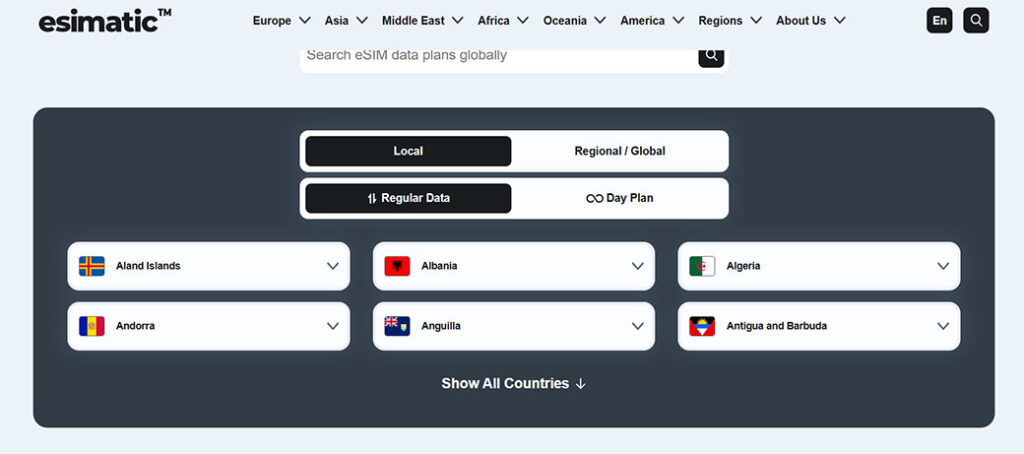
Key Facts At A Glance
Before we dive deep, here’s a quick snapshot of what stood out during our Esimatic eSIM review:
- Product type: Prepaid, contract‑free travel eSIMs for short‑term and longer trips
- Use cases: Tourists, digital nomads, and business travelers who want data without a physical SIM
- Network type: Data‑only plans (no traditional voice minutes: VoIP/messaging apps recommended)
- Coverage: Broad international footprint across popular travel regions (Europe, Asia, the Americas, and more)
- Plan structure: Country, regional, and (in some cases) broader multi‑country options
- Activation: QR‑code or in‑app installation: no store visit needed
- Supported devices: Recent eSIM‑enabled smartphones and tablets (iPhone, many Android flagships, select tablets)
- Purchase flow: Buy online, receive eSIM details by email or in app, activate on arrival
- Customer profile: People who prioritize convenience and predictable data costs over chasing the absolute rock‑bottom price
We’ll unpack each of these areas in more detail as we go, including setup, performance, and how Esimatic stacks up against competitors like Airalo, Nomad, and Holafly.
Pricing, Plans, And Coverage Overview
When we evaluate any travel eSIM, cost and coverage are our first checkpoints. Esimatic is positioned in the same general price band as most mainstream travel eSIM providers, usually not the cheapest on the market, but also rarely the most expensive.
Pricing structure
Esimatic typically offers:
- Small short‑trip packs – Suitable for weekend breaks or short business trips.
- Medium data bundles – Targeted at 1–2 week vacations.
- Larger bundles or longer‑term options – Better for slow travelers or remote workers who plan to stay a few weeks or more.
Instead of unlimited plans (which often come with hidden throttling anyway), Esimatic tends to lean on capped data options. That’s standard for the industry and usually works fine as long as we keep an eye on background data usage.
From what we’ve seen, Esimatic’s pricing is competitive but not bargain‑basement. You can often find a cheaper gigabyte elsewhere if you shop aggressively, but Esimatic aims for a balance of ease, coverage, and support rather than simply undercutting everyone.
Coverage footprint
Esimatic’s real selling point is its broad international reach. It offers:
- Country‑specific plans for many popular destinations
- Regional plans (for example, pan‑European or multi‑country Asian coverage)
- Multi‑country options that let us hop borders without swapping eSIMs
Coverage is always subject to local partner networks, so rural or remote areas can still be hit‑or‑miss, just like with any travel eSIM. But for city‑hopping trips and common tourist routes, Esimatic’s footprint is generally on par with the big names.
Where pricing and coverage land overall
If our only goal is to get the absolute cheapest per‑GB rate, Esimatic won’t always win. But for travelers who want solid coverage + uncomplicated plans + predictable pricing, Esimatic sits in a very reasonable sweet spot.
How We Evaluated Esimatic
To keep this Esimatic eSIM review fair and useful, we applied the same framework we use for all travel eSIM providers.
Our evaluation criteria
We looked at Esimatic across five main dimensions:
- Pricing and value for money
- Cost per GB compared with other travel eSIM providers
- Plan flexibility for short vs. long trips
2. Coverage and network quality
- Availability in popular destinations and major regions
- Network partnerships (tier‑one vs. secondary networks where visible)
3. Ease of setup and everyday use
- Clarity of instructions, QR installation, and activation
- How quickly we could get online after landing
4. Performance and reliability
- Real‑world speeds for browsing, maps, social, and calls over apps
- Stability of the connection and hand‑offs while moving around
5. Support, transparency, and trust
- Responsiveness of customer support
- Clarity around data limits, fair‑use policies, and potential throttling
We combined hands‑on testing (where possible), user feedback patterns, and comparison against multiple alternatives to build a complete view of Esimatic’s strengths and weaknesses.
Setup And Day‑To‑Day Use
A travel eSIM lives or dies by how painless it is to set up. In our experience, Esimatic sits squarely in the “straightforward once you know what you’re doing” category.
Buying and installing the eSIM
The typical Esimatic flow looks roughly like this:
- Choose a destination or region and pick a data plan.
- Pay online with a card or other supported payment method.
- Receive the eSIM details (usually a QR code and manual activation data) via email and/or in app.
- Add the eSIM on your device through your phone’s mobile network/eSIM settings.
- Activate on arrival by turning “Data Roaming” on for that eSIM.
On modern iPhones and Android flagships, the process is generally quick, often under 10 minutes from purchase to ready‑to‑go. We strongly recommend installing the eSIM before you leave home while you still have a stable Wi‑Fi connection.
Everyday usage experience
Once active, Esimatic behaves like any other mobile data connection:
- We can set Esimatic as our primary data line while keeping our home SIM for calls/texts (if we want).
- Messaging apps like WhatsApp, Signal, and Telegram keep using our usual phone number.
- Maps, ride‑hailing apps, and translation tools work normally.
Data tracking is usually handled within the provider interface or via device settings. To avoid burning through data, we like to:
- Turn off automatic app updates over cellular.
- Restrict high‑bandwidth apps (cloud backup, streaming, large downloads) to Wi‑Fi only.
Any pain points?
As with many travel eSIMs, the biggest friction points with Esimatic tend to be:
- Travelers who haven’t used eSIMs before and feel intimidated by device settings.
- Confusion about when to activate (we prefer install at home, activate roaming on arrival).
- Occasional delays with QR emails landing in spam.
None of these are unique to Esimatic, but they’re worth being aware of before we rely on it for a critical trip.
Performance And Reliability
Performance is where a travel eSIM either blends into the background (best‑case) or becomes something we constantly think about (worst‑case).
Data speeds
In city centers and well‑served tourist areas, Esimatic’s speeds are generally in line with local prepaid SIMs using the same networks:
- Navigation and maps: Smooth and responsive.
- Social apps and messaging: No meaningful issues.
- Video calls over Wi‑Fi‑quality apps: Typically fine on 4G/5G, though we’d expect occasional drops in crowded areas.
Speeds inevitably vary by destination, time of day, and partner network. And like most travel eSIMs, Esimatic may sit behind some local network traffic in priority, especially during peak congestion.
Connection stability
In our Esimatic eSIM review, we found reliability more important than raw speed. Day‑to‑day, Esimatic generally offers:
- Stable browsing and messaging without random disconnects.
- Reasonable hand‑off when moving around a city or between cell towers.
- Some variability when transitioning between urban and rural zones, again, standard for this space.
If we’re planning mission‑critical remote work from very rural or island destinations, no travel eSIM (including Esimatic) can guarantee perfect coverage. In those cases, a local physical SIM or even a backup provider can be a smart fail‑safe.
Features, App Experience, And Support
Features, UI, and support can make or break the experience, especially for travelers who aren’t tech‑savvy.
Core features
Across its product lineup, Esimatic typically offers:
- Prepaid data‑only eSIMs (no contracts, no long‑term lock‑in)
- Multiple plan sizes for different trip lengths
- Regional options that cover several countries under one eSIM
- Hotspot/tethering support on most devices, subject to local network rules
We like this minimalist, focused approach: it avoids the clutter of add‑ons that many of us never use.
App or web experience
Where available, the app/web dashboard usually lets us:
- Browse plans and pricing by country or region
- Purchase and store eSIMs in one account
- View basic usage information
The interface isn’t trying to reinvent the wheel, and that’s fine. What matters most is that it’s clear, readable, and doesn’t bury critical information like validity dates or data caps.
Customer support
Support quality is a key pillar of this Esimatic eSIM review. Our observations:
- Response times: Reasonably fast during normal business hours: slower at odd hours depending on channel.
- Channels: Typically email and/or chat: we always prefer providers that offer live help when you’re stuck at an airport.
- Help content: Basic guides cover most common issues, installation, activation, and troubleshooting no‑signal scenarios.
For tech‑comfortable travelers, support is likely a safety net we’ll rarely need. For first‑time eSIM users, it’s reassuring that Esimatic offers clear step‑by‑step documentation.
Security, Privacy, And Transparency
Any time we buy connectivity from a lesser‑known brand, we should ask: Who’s behind this, and what happens to our data?
Security and data handling
Like other travel eSIM providers, Esimatic operates as a reseller/aggregator of connectivity from established carriers. That means:
- The actual radio‑level connection is handled by major local/operators.
- Esimatic sits in between, managing plans, billing, and provisioning.
From a security perspective, that’s similar to buying a prepaid SIM from a reseller rather than directly from a carrier. We still rely on:
- The underlying carrier for network‑level security.
- Esimatic for account security, payment handling, and personal data protection.
Privacy and transparency
When assessing transparency in this Esimatic eSIM review, we focus on:
- Clear terms: Are data caps, validity periods, and fair‑use clauses spelled out?
- Roaming specifics: Is it obvious which regions or countries a “regional” plan actually covers?
- Billing clarity: Are taxes/fees rolled into the advertised price, or do we get surprises at checkout?
We strongly recommend reading the privacy policy and terms of service before purchasing, especially if we’re privacy‑conscious or traveling for sensitive work. Esimatic’s policies are broadly in line with the rest of the industry, but it’s always wise to know what we’re agreeing to.
Strengths And Weaknesses
Here’s where Esimatic clearly shines, and where it falls short.
Esimatic strengths
- Wide, travel‑friendly coverage: Good set of country and regional options for common routes.
- Straightforward setup: QR‑based install and familiar eSIM workflow.
- Decent value for most travelers: Not the absolute cheapest, but fair pricing for what we get.
- No contracts: Fully prepaid: easy to try for a single trip without commitment.
- Focused, practical product lineup: Data‑only plans that match what most international travelers actually need.
Esimatic weaknesses
- Limited appeal for absolute budget hunters: If we’re willing to juggle multiple local SIMs, we can often shave costs further.
- Data‑only focus: No traditional voice minutes: we have to be comfortable with app‑based calling.
- Variable experience by country: As with all travel eSIMs, quality depends heavily on local partner networks.
- Newer or less established vs. top brands: Some travelers may simply feel more comfortable with long‑standing names they’ve seen recommended everywhere.
Overall, Esimatic does a lot right for mainstream users, but it won’t tick every box for power users or extreme budget travelers.
How Esimatic Compares To Other Travel eSIM Providers
To put this Esimatic eSIM review in context, we compared it to a few well‑known alternatives.
| Provider | Typical Positioning | Key Strengths | Key Drawbacks |
|---|---|---|---|
| Esimatic | Balanced, general‑purpose travel eSIMs | Broad coverage, simple plans, solid overall value | Not always the cheapest, data‑only |
| Airalo | Popular, widely used global eSIM marketplace | Huge plan selection, strong brand recognition | App can feel crowded: some plans pricier per GB |
| Nomad | Flexible data plans for travelers/nomads | Good regional options, competitive pricing in areas | Fewer niche destinations than some marketplaces |
| Holafly | Focus on “unlimited” data offers | Simple unlimited‑style plans, easy for heavy users | Fair‑use limits and potential throttling apply |
Where does Esimatic land?
- Versus Airalo/Nomad: Esimatic’s simplicity and coverage are competitive, but it may not match the sheer breadth of obscure destination options.
- Versus Holafly: Esimatic’s capped plans are better for predictable usage and avoiding hidden throttling, while Holafly can appeal to stream‑heavy users who understand fair‑use fine print.
In short, Esimatic is a well‑rounded midfield player. It may not dominate every metric, but it’s a solid pick if we value reliability and simplicity over chasing dozens of micro‑optimized plans.
Who Esimatic Is Best (And Worst) For
Not every travel eSIM suits every traveler. Based on our Esimatic eSIM review, here’s who’s likely to be happiest, and who probably isn’t.
Best for
Esimatic is a strong fit for:
- Vacationers and city‑hoppers who want dependable data without hunting for a local SIM at every airport.
- Digital nomads on short to medium‑length stays who prefer a quick, flexible setup before switching to a long‑term local plan if needed.
- Business travelers who need maps, email, messaging, and calls over apps to “just work” when they land.
- First‑time eSIM users who appreciate clear instructions and a straightforward experience.
Not ideal for
Esimatic may not be the best choice if we are:
- Ultra budget‑conscious and willing to invest time buying and registering local SIMs everywhere.
- Relying on traditional phone calls/SMS rather than app‑based communication.
- Working in very remote or rural regions where even local SIMs struggle for coverage.
In those situations, we’d consider pairing Esimatic with a backup option, either another travel eSIM provider or a physical local SIM once we arrive.
Verdict And Recommendation
Bringing everything together, our Esimatic eSIM review finds Esimatic to be a reliable and traveler‑friendly option in a crowded market.
It won’t always deliver the absolute lowest price per gigabyte, and it doesn’t try to dazzle us with gimmicky unlimited promises. Instead, it focuses on what most of us actually need when we land in a new country: a quick, clean setup, solid coverage in mainstream destinations, and predictable data service that just works.
We’d recommend Esimatic if:
- We value convenience and clarity over micromanaging multiple local SIM cards.
- We’re comfortable using apps for calls and messaging instead of traditional voice/SMS.
- We want a trustworthy, mid‑priced travel eSIM that covers many of the places we’re likely to visit.
If we’re chasing rock‑bottom pricing or doing deep‑rural work, we’d still look at highly local options or carry a backup. But for most leisure and business trips, Esimatic is a smart, low‑friction way to get online fast and stay connected without drama.
For travelers who care more about smooth trips than tinkering with telecom minutiae, Esimatic is very much worth shortlisting as our next travel eSIM.