





Landing in Mexico with no data signal used to be my worst travel habit. Every time I told myself I’d “just find WiFi,” and every time I ended up stuck outside the airport hunting for a password that never came.
Since I switched to using an eSIM for Mexico, my trips feel completely different. I order a plan in a couple of minutes, scan a QR code, and walk out of the airport already connected to maps, ride apps, WhatsApp, and translation tools. Nothing kills that first day excitement faster than roaming charges or getting lost because you can’t load directions.
Because you’re here, I know you want the same thing I want when I travel: a simple, reliable, and fairly priced way to stay online. I wrote this guide in plain language, based on what actually matters when I’m choosing the best eSIM for Mexico – coverage where people really go, enough data to avoid nasty surprises, and flexibility for different travel styles.
By the end of this guide, you’ll know exactly what to look for, which types of eSIM plans work best for your kind of trip, and how to set everything up before you even board the plane.
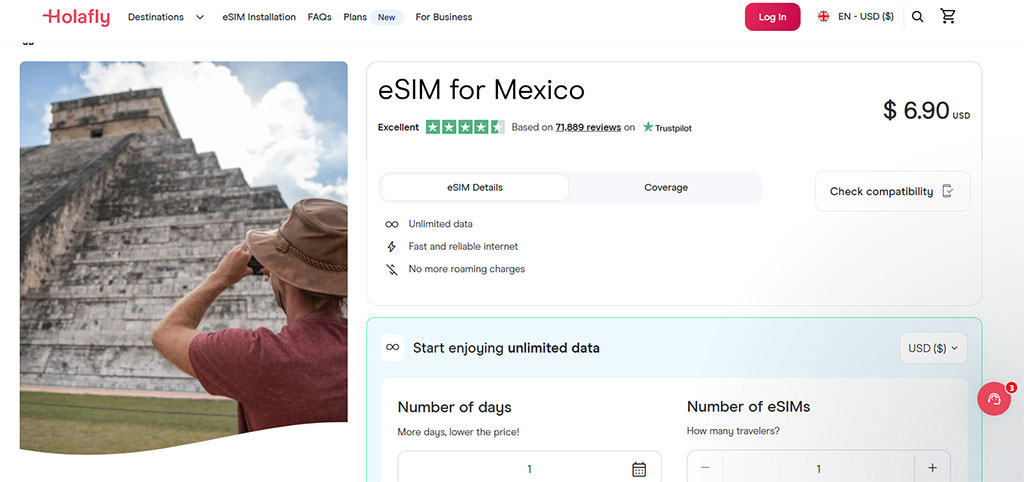
Why Use The Best eSIM In Mexico
What An eSIM Is And How It Works
Every time I explain eSIMs to friends, I describe them as a built in digital SIM card already sitting inside your phone, just waiting for you to turn it on. Instead of buying a small plastic card and swapping it in and out, I simply download a mobile plan directly to my device.
Most modern phones from Apple, Samsung, Google, and other big brands now support at least one eSIM. Many newer iPhones even ship with eSIM only, which shows how quickly this tech is becoming the default.
When I buy an eSIM plan for Mexico, the provider sends me either a QR code or directs me to install their app. After I scan the code or tap “install,” my phone adds a new mobile profile with its own number (sometimes) and its own data plan. Then I decide which one handles data, calls, and texts. Once I land, all I usually need to do is switch data to the Mexico eSIM and I’m online.
Benefits Of eSIMs Over Physical SIM Cards In Mexico
Whenever I compare eSIMs with the old physical SIM cards for Mexico, a few advantages always stand out for me:
- I stay connected from the moment the plane lands because the eSIM plan is already active or ready to activate.
- I avoid long lines at airport kiosks and the stress of comparing plans when I’m tired and just want to drop my bags.
- I keep my home number active for messages, banking codes, and two factor logins while using the Mexico eSIM for data.
- I don’t risk losing or damaging my original SIM because it stays inside the phone the whole time.
Some travelers still like physical SIMs, and I understand the appeal of walking into a store and talking to a real person. Still, for short and medium term trips in Mexico, I now consistently find eSIMs more convenient and often more cost effective, especially when I factor in my time and the hassle they save.
Coverage, Speed, And Network Quality In Mexico
Whenever I look at the best eSIM for Mexico, coverage sits at the top of my checklist. Mexico has strong mobile networks in major cities like Mexico City, Guadalajara, and Monterrey, as well as in popular beach destinations like Cancun, Playa del Carmen, Tulum, Puerto Vallarta, and Los Cabos.
Most international eSIM providers partner with the largest Mexican carriers, which usually means solid 4G or LTE coverage in urban and tourist areas. Outside the main routes and in rural or mountainous regions, signal can drop, and speeds can slow down. I rarely worry about that for city breaks, but I pay closer attention if I’m planning a road trip across multiple states.
Whenever I filter through plans, I treat network quality like this:
- In big cities and resorts, most reputable eSIMs feel similar in day to day use.
- On bus rides, inland routes, and remote beaches, I look for eSIMs that clearly mention partnerships with major carriers or highlight extended coverage.
- For work heavy trips, I favor plans that explicitly offer 4G or better on primary networks, not just vague “coverage across Mexico” promises.
My priority always stays the same: a stable connection for maps, messaging, ride apps, restaurant searches, music, and occasional video calls. For that daily reality, eSIMs that tap into top Mexican networks usually deliver exactly what I need.
Key Factors To Compare When Choosing A Mexico eSIM
Coverage Across Cities, Beaches, And Rural Areas
Whenever I compare Mexico eSIMs, I start with a simple question: where am I actually going. City trips to Mexico City or Cancun demand less from a network than a long drive across Yucatan or a surf mission on the Pacific coast.
If my itinerary sits mostly in big cities and popular tourist zones, I treat most well known eSIM brands as roughly comparable. Nearly all of them lean on the big Mexican carriers, which means I get solid coverage and speeds where most travelers spend their time.
If I plan to explore smaller towns, cenotes off the main road, or less visited beaches, I dig deeper. I look for:
- Named partner networks (for example, plans that mention major national carriers rather than generic “local networks”).
- Coverage maps on the provider’s site, even if they’re approximate.
- Real industry notes from other travelers describing performance away from tourist hubs.
While I can’t rely on any single promise as absolute, I treat visible details about coverage as a priority signal. Providers that clearly explain where they work best usually take their network partnerships more seriously.
Data Allowances, Speed Limits, And Fair Use Policies
Data size and speed limits probably influence my choice more than anything else. Whenever I travel, I ask myself three questions:
- How often will I be on WiFi at my accommodation or coworking space.
- How much video, maps, and social media do I plan to use on data.
- How much flexibility do I want if my plans change mid trip.
Many Mexico eSIMs advertise “unlimited” data, but the important piece often hides in the fair use policy. I’ve seen offers that look generous at first peek but slow down sharply after a certain high speed data cap. Because I dislike surprises, I always check:
- The exact amount of high speed data included (for example, a exact number of GB).
- Whether speeds are throttled after I hit that amount.
- Any per day cap that might affect streaming or long video calls.
Whenever I choose, I usually prefer a clearly stated high speed allowance over vague unlimited promises. I find it easier to plan around a known limit than to guess when the provider might slow my connection.
Validity Periods, Top Ups, And Flexibility
Trip length and plan validity can either align perfectly or create a headache halfway through a vacation. Short term visitors often see options like 5, 7, 10, or 15 day plans with fixed data bundles. Longer stay travelers see month based plans or packages that cover multiple weeks.
Whenever my trip overlaps awkwardly with these validity windows, I consider two approaches:
- I buy a plan that comfortably covers the entire stay, even if it includes a little more data than I expect to use.
- I pick a slightly smaller plan from a provider that lets me add top ups easily through an app.
Flexibility matters most when my schedule isn’t fixed. If I might extend from 10 days to 3 weeks, I deliberately choose an eSIM brand known for easy renewals or plan switches without requiring a new QR code. I value that simplicity far more than squeezing every last dollar out of the first purchase.
Roaming, Hotspot Tethering, And Dual SIM Use
Travel for me usually means juggling work, personal life, and sometimes friends or family back home, so I care a lot about how an eSIM handles extra features.
I check if:
- Hotspot tethering is allowed so I can share data with a laptop or tablet.
- Roaming in nearby countries is supported, especially if I’m crossing into the United States, Belize, or Guatemala.
- Dual SIM behavior is clear, including whether I can keep my home number active for calls and messages while using Mexico data on the eSIM.
Tethering rules vary a lot. Some plans allow full hotspot use, others restrict or discourage it, and a few block it entirely. Because I don’t want my laptop to suddenly lose connection mid call, I always confirm tethering policy before paying.
Dual SIM flexibility is another area I prioritize. I like keeping my home SIM for calls and SMS, with data routed through the Mexico eSIM. When a provider clearly explains how their plan interacts with existing lines, I trust them more.
Compatibility, Activation, And Customer Support
Before I buy anything, I double check that my phone supports eSIM and that it isn’t carrier locked. Most modern flagship phones are ready, but I still verify because activation problems usually trace back to compatibility issues.
I also pay attention to the activation process. I personally prefer providers that:
- Offer a clean, simple app or a straightforward QR code.
- Provide clear step by step setup instructions for iOS and Android.
- Let me choose activation timing, either immediately or on first connection in Mexico.
Customer support rounds out my priorities. I don’t expect to use it often, but when something goes wrong, fast access to chat or email can save a day of my trip. I look for:
- Real support channels like live chat or responsive email.
- Set hours clearly listed, preferably with at least some coverage in my own time zone.
- Concise troubleshooting guides so I can fix easy issues on my own.
Best eSIM Options For Different Types Of Travelers
Short Vacations And City Breaks (Up To 7–10 Days)
Whenever I visit Mexico for a quick city break or a week at the beach, I focus on simplicity and predictable costs. Short trips usually mean lots of maps, ride apps, restaurant searches, social media, and photo uploads. Video streaming on mobile data stays minimal because I’m often on hotel or Airbnb WiFi in the evenings.
For this kind of trip, I almost always go for:
- A 7 to 10 day eSIM plan with a clear data cap.
- Enough high speed data for daily use, usually in the mid range rather than the smallest possible bundle.
- Instant activation and easy setup so I don’t waste time at the airport.
Any of the well known international travel eSIM providers that partner with Mexico’s main networks usually work well here. I prioritize a balance of reasonable price and hassle free activation over chasing the absolute cheapest gigabyte.
Backpackers And Road Trips (2–4 Weeks)
Longer trips across Mexico introduce more uncertainty. While I expect to hit big cities, I also know I might detour to small towns or remote beaches that don’t show up on most tourists’ first itineraries.
Backpacking or driving around Mexico pushes me to look for:
- At least a monthly plan or multiple smaller plans that I can stack or renew.
- Solid coverage on major highways and in secondary cities.
- Fair policies on roaming between regions within Mexico and consistent speeds.
For this style of travel, I often consider:
- Larger data bundles that give me breathing room for music streaming and navigation during long bus rides.
- Providers that allow top ups without reinstalling a new eSIM profile.
- Possibly a local Mexican eSIM from a national carrier if I plan a lot of off the grid exploring.
Because every day can look different, flexibility and network reach matter more to me than squeezing the last cent out of the base price.
Remote Workers And Digital Nomads (1–6 Months)
Working from Mexico changes the equation completely. I suddenly care less about tourist attractions and more about stable video calls, large file uploads, and redundancy if the main connection fails.
Remote work pushes me to treat a Mexico eSIM as one piece of a broader connectivity strategy. I usually:
- Get a reliable, higher data or month to month eSIM that uses a major Mexican network.
- Combine it with local WiFi at home, coworking spaces, or long stay rentals.
- Keep a backup plan, either another provider’s eSIM or the option to tether from a second line.
For one to six month stays, I sometimes lean toward local Mexican carrier eSIMs because they often integrate better into the country’s mobile network. But, international eSIMs still appeal to me when I expect to bounce between Mexico and other Latin American countries.
My key priorities in this case are:
- Transparent high speed data amounts and throttle points.
- Tethering permission so I can fall back on mobile data if WiFi drops.
- Reasonable monthly costs that don’t punish me for staying longer.
Frequent Travelers Across Latin America
If I know I’ll be moving through Mexico, then on to other countries like Colombia, Costa Rica, or Brazil, I put regional coverage high on my list. A multi country Latin America eSIM sometimes beats buying separate local plans, even if the price per gigabyte is a bit higher.
I look for:
- Regional or global eSIM plans that explicitly include Mexico plus my other destinations.
- Simple roaming rules across borders so I don’t have to juggle multiple QR codes.
- Enough total data to span flights, buses, and stays in different cities.
Sometimes I pair a regional eSIM for the whole itinerary with a short local Mexico eSIM at the start, especially if I want stronger speeds in the first country or if the regional plan only activates later. That way I stay online everywhere without having to rethink my setup at every border.
Tourists Arriving On Cruises Or Overland From The US
Arriving in Mexico by cruise ship or by car from the United States changes how I think about activation and coverage zones. Cruise itineraries often include multiple ports for short stops, while driving from the US means crossing a land border where network changes can confuse some phones.
For cruise travelers, I prefer:
- An eSIM that I can activate before reaching the first Mexican port.
- Clear rules about when the plan works (land only, or also near the shore).
- Enough short term data for maps, local apps, and messaging during port days.
For overland travelers from the US, I usually:
- Keep my US plan active for the American side of the journey.
- Install and configure the Mexico eSIM in advance, but set it to activate only once I cross the border.
- Verify that roaming between the US and Mexico won’t cause unexpected charges.
These travel styles make me much more sensitive to fine print about roaming and activation triggers, so I carefully read how each eSIM handles country detection and network switching.
International eSIM Providers Versus Local Mexican eSIMs
Pros And Cons Of International Travel eSIM Providers
International travel eSIM providers feel incredibly convenient to me. I can buy a Mexico plan from my couch before the trip, use the same app for multiple countries, and avoid any language barrier at local phone shops.
The main advantages I experience are:
- Easy online purchase and instant delivery via QR code or app.
- Familiar interfaces if I’ve used the brand in other countries.
- Sometimes available multi country or global plans that fit complex itineraries.
Some drawbacks do exist, and I keep them in mind:
- Prices per gigabyte can be higher than what locals pay on native carriers.
- Customer support may not always have deep knowledge of exact Mexican network quirks.
- Fair use policies can be stricter, especially around tethering and high speed data caps.
Even though those limitations, I still choose international eSIMs for most short trips because the overall experience feels smoother. I pay slightly more in some cases, but the time and frustration I save at arrival usually makes it worth it.
Pros And Cons Of Local Mexican Carrier eSIMs
Local Mexican carriers also offer eSIM plans, and they become more attractive the longer I stay. I’ve noticed that being on a native network sometimes gives me:
- Better integration with local promotions, add ons, and extra services.
- Potentially better value on large data bundles and long term plans.
- Customer support deeply familiar with Mexican coverage realities.
Choosing a local Mexican eSIM can come with challenges:
- In person sign up may be required, which costs time soon after arrival.
- Documentation or ID rules might feel stricter than what tourists expect.
- Language barriers can appear in stores or in support channels.
When I weigh these against international providers, I usually lean toward local eSIMs if I’m living in Mexico for several months or more, or if I want to align as closely as possible with how residents access mobile data.
Where To Buy: Online, At The Airport, Or In Store
Deciding where to buy a Mexico eSIM shapes my first day on the ground. Online purchase is my default choice now:
- I use my home WiFi to compare offers calmly.
- I install and test the profile before I travel.
- I avoid airport lines and language stress while jet lagged.
The airport remains an option, especially for travelers who like seeing a person face to face. I treat airport kiosks as a backup if my pre purchased eSIM fails or if friends join the trip unprepared.
In store purchases with local carriers matter more for longer stays or when I want a local number with voice and text included. I plan extra time for this, and I often do it a day or two after arrival, once the urgency has passed and I can navigate a store more comfortably.
By deliberately choosing when and where to buy, I keep control of my first hours in the country instead of letting connectivity problems dictate them.
How To Set Up And Use Your Mexico eSIM Step By Step
Checking Phone Compatibility Before You Buy
Before I spend a cent, I confirm that my phone supports eSIM and that it’s unlocked. I go into my device settings and look for an option to add a mobile plan or a digital SIM. If I see that option, I know I’m in good shape.
I also verify with my current carrier that my phone isn’t locked to their network. If it is, I request an unlock well before the trip, because that process can take time. Without this step, even the best Mexico eSIM will fail to activate.
Buying And Installing The eSIM QR Code Or App
Once compatibility is clear, I go to the eSIM provider’s site or app, choose Mexico as my destination, pick a plan that matches my data needs and trip length, and complete the purchase.
After payment, I typically receive one of two things:
- A QR code that I can scan using my phone’s camera through the mobile network settings.
- A direct installation flow inside the provider’s app.
On iOS, I visit Settings → Cellular or Mobile Data → Add eSIM or Add Cellular Plan, then follow the prompts. On Android, the path varies slightly by brand, but I look for Network or SIM settings and the option to add a new eSIM.
I always install the eSIM while I still have reliable WiFi at home so that downloads and updates work smoothly.
Configuring Data Plans, APN Settings, And Roaming
Once the eSIM appears on my phone, I give it a clear label such as “Mexico Data” so I can distinguish it from my home line.
I then set:
- Which SIM handles mobile data (usually the Mexico eSIM during the trip).
- Which SIM, if any, handles calls and SMS (often my home line for banking codes and important messages).
- Whether roaming is enabled for the Mexico eSIM, according to the provider’s instructions.
Most modern eSIM plans configure APN settings automatically. If data doesn’t work at first, I check the provider’s help page for manual APN details, then input them under mobile network settings.
Before I leave, I run a quick test by temporarily forcing the phone onto the eSIM for data and visiting a website. If it loads, I feel confident that everything will function once I land in Mexico.
Managing Data Usage And Preventing Bill Shock
Even though eSIMs for Mexico normally work on prepaid or fixed allowance models, I still watch my data usage closely. I don’t want to burn through my entire plan in a couple of heavy streaming days.
I set a mobile data warning and limit inside my phone’s settings, aligned with my plan size. I keep automatic cloud backups, large app updates, and high resolution video uploads restricted to WiFi.
I also:
- Download offline maps for cities and regions I’ll visit.
- Save playlists, podcasts, and Netflix shows before the trip.
- Lower streaming quality in apps when I’m on mobile data.
By doing this, I stretch my eSIM plan comfortably and avoid urgently buying top ups when I could have easily managed my usage a bit better.
Common Issues And Troubleshooting Tips For Mexico eSIMs
No Signal Or Weak Signal Issues
When I suddenly see “no service” or a weak signal on my Mexico eSIM, I start with a location check. I ask myself if I’m in a basement, elevator, remote valley, or thick walled building that might naturally block signal.
If the environment looks fine, I:
- Toggle airplane mode on and off to force a network refresh.
- Restart the phone, which often clears minor glitches.
- Verify that mobile data is enabled for the Mexico eSIM specifically.
If those quick steps fail, I open my phone’s network settings and try selecting the Mexican carrier manually instead of leaving it on automatic. Sometimes that manual nudge gets the eSIM talking correctly to the local network again.
eSIM Not Activating Or Failing To Download
Activation or download failures usually point to one of three things for me: poor WiFi during installation, a compatibility mismatch, or a temporary issue on the provider’s side.
When a new eSIM profile refuses to download, I:
- Switch to the most stable WiFi connection available.
- Double check that I scanned the correct QR code for my device.
- Confirm that my phone’s software is up to date.
If activation still fails after those checks, I contact the provider’s support with screenshots. I prefer doing this before my trip if possible so I’m not debugging in an airport.
Issues With Hotspot Tethering Or Dual SIM Conflicts
When tethering doesn’t work, I first confirm that my plan actually allows hotspot use. If it does, I:
- Toggle hotspot off and back on.
- Restart both the phone and the device I’m trying to connect.
- Check that the device connects to the correct WiFi network name.
Dual SIM conflicts sometimes appear when both my home SIM and the Mexico eSIM try to handle data or calls at the same time. If calls drop or data routes strangely, I:
- Choose one SIM for data only and disable data on the other.
- Decide which SIM should handle voice and turn off voice on the secondary line.
- Confirm that roaming settings match my intended usage.
Usually, cleaning up those overlapping roles makes the phone behave predictably again.
When To Contact Support Or Switch Plans
At some point, repeated tinkering stops being worth my time. If I:
- Face persistent connection problems in areas where others clearly have service.
- See errors that I can’t interpret even after reading the provider’s help pages.
- Notice unexpected throttling or behavior that contradicts the plan description.
Then I reach out to support with specifics: screenshots, locations, times of day, and any error messages. This context helps them diagnose issues much faster.
If support can’t fix the problem or if the experience feels consistently unreliable, I don’t hesitate to switch to another eSIM provider or a local Mexican carrier. My connection remains too important, especially for work, to stay stuck with a plan that doesn’t deliver.
Conclusion
Every time I plan a trip to Mexico now, I treat the eSIM as essential infrastructure, not an afterthought. I know that the best eSIM for Mexico depends on how long I’m staying, where I’m going, and how heavily I rely on data for work or play.
Because I focus first on coverage, clear data allowances, and flexible validity, I consistently avoid the two big headaches that used to haunt my trips: surprise costs and unreliable signal. I use international travel eSIMs for short and simple visits, and I consider local Mexican eSIMs from major carriers when I stay longer or want to squeeze maximum value from large bundles.
If you follow the same approach, you’ll step off the plane already connected, ready to order a ride, message your accommodation, and navigate a new city without stress. When your data plan just works quietly in the background, your attention can go back where it belongs: the food, the people, the beaches, and the experiences you came to Mexico to enjoy.
[…] identifying and utilizing the best eSim for China isn’t merely an option – it’s a necessity for unimpeded, cost-effective connectivity. It’s about making […]