





Buying a local SIM card after you land used to be a travel ritual: find a kiosk, show your passport, wait for activation, and hope your phone settings cooperate.
eSIMs change that.
With an eSIM, you can set everything up before you leave home, land with working data, and switch between countries without swapping tiny pieces of plastic.
This article focuses on the practical benefits of using eSIM for international travel – not just the tech. We’ll look at:
- Convenience at the airport and during your trip
- How eSIM can save you money versus roaming
- Why dual‑SIM setups are so powerful for travelers
- Extra perks like safety, backup connectivity, and flexibility
By the end, you’ll have a clear sense of whether an eSIM is worth it for how you travel.
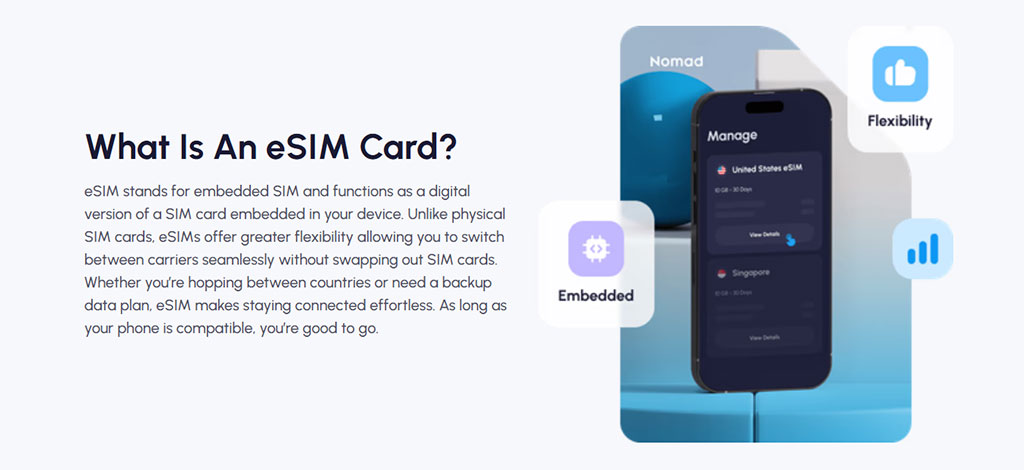
What Is An eSIM And How Does It Work When You Travel?
An eSIM is a digital SIM card that is built directly into your phone, tablet, or smartwatch. You do not insert anything physical. You simply download a mobile plan as a small profile through a QR code or an app, and your device connects to a local carrier network.
Instead of swapping plastic SIM cards every time you cross a border, you store multiple plans digitally and switch between them in your settings.
How eSIM behaves when you travel
When you travel internationally with an eSIM:
1. You buy an international or local plan before or during your trip.
You choose a country or region, select data and duration, then pay online.
2. You receive a QR code or activation link.
You scan it with your phone camera or open it through the provider app.
3. Your device installs the eSIM profile.
Your phone now holds two or more lines at once, like a built in dual SIM setup.
4. You pick which line handles data, calls, and messages.
You can keep your home number active while using the eSIM for cheaper local data.
5. You start using data as soon as the plan becomes active.
Some plans activate immediately, others only start when you land and connect to a partner network.
Every step happens in your phone software. You never touch a paper clip, never risk losing your original SIM, and never stand in a foreign store trying to explain what plan you need.
Why eSIM Is A Game-Changer For International Travelers
You may be wondering why you should change anything if your current roaming just about works. You might also feel that local prepaid SIM cards are fine, even if they take a bit of effort.
The reason eSIM feels like a real shift is that it solves several travel headaches at once:
- You remove the need to hunt for a store after a long flight.
- You stop guessing what your roaming bill will look like.
- You keep your primary number for important calls and two factor codes.
- You stack and switch multiple country plans in a single device.
When you put those together, the Benefits of Using eSIM for International Travel become less about a technical upgrade and more about how confidently you can move between countries.
Imagine this scenario. You work remotely and visit three countries in one month. With traditional SIM cards, you would queue three times, handle three sets of instructions, and manage three tiny pieces of plastic that can easily be lost. With eSIM, you install three plans in advance, let each one activate when you land, and tap between them in settings. Your attention stays on your work and your trip, not on your phone admin.
That is what makes eSIM a practical upgrade, not just a trendy feature.
Save Money And Avoid Surprise Roaming Charges
International roaming from your home carrier is famously expensive. Even if they offer day passes, it’s easy to lose track and end up with a big bill.
With an eSIM, you:
- See the exact price and data allowance before you buy.
- Can choose from multiple providers and compare value.
- Often pay a flat price in your own currency.
If you know you’ll use a lot of data (maps, YouTube, remote work), this level of control can save you a lot versus “pay as you roam” daily fees.
Why roaming is often so expensive
Traditional global roaming through your home carrier usually means:
- High daily passes that add up quickly on long trips
- Confusing per megabyte or per minute pricing
- Limited data that pushes you to buy top ups
You rarely see a clear total cost upfront. You only truly know what you spent when the bill lands.
How eSIM helps you control your costs
With an eSIM plan designed for international travel, you usually see:
- Transparent pricing: You choose a package like 5 GB for 7 days or 20 GB for 30 days.
- Upfront payment: You pay once and know exactly what you get.
- Local or regional rates: You often pay closer to what locals pay, not inflated roaming margins.
You do not need to rely on your home carrier roaming at all. You keep your physical SIM dormant for data, set your eSIM as the data line, and connect to the local partner network.
If you mainly use maps, messages, ride hailing, and some social media, a single eSIM package may easily cover your whole trip. You stay connected, but you do not get any nasty billing surprises later.
Enjoy Instant Connectivity The Moment You Land
You step off the plane, switch off airplane mode, and your phone simply works. You open your messages, order a ride, or check your hotel booking without hunting for Wi Fi or lining up for a SIM card.
That instant connection is one of the biggest Benefits of Using eSIM for International Travel.
Skip the Airport SIM Hunt
One of the biggest benefits of eSIM is pure convenience.
With a traditional SIM card, you have to:
- Find a shop or kiosk that’s open when you land
- Compare plans in a language you might not speak
- Hand over your passport and wait while they register your SIM
- Swap cards and hope everything works
With an eSIM:
- You buy and install the plan before you fly (or on airport Wi‑Fi).
- When you land, you turn on the eSIM data line and start using your phone.
That means no queues, no paperwork, and no hunting for a shop when you’re tired from a long flight.our first hour in a new place doing phone admin instead of heading straight to your hotel or meeting.
Set everything up before you leave
With an eSIM you:
- Browse and purchase plans from home in your own language
- Install the profile a day or two before departure
- Let activation start when your plane lands and the phone sees the local network
You walk off the plane and your phone negotiates with the partner carrier automatically. You do not lose time, you do not feel rushed, and you are already prepared if you need maps, translation apps, or a ride.
Keep Your Home Number and Use Local Data
Most modern phones with eSIM support can run at least two lines at once:
- Your home SIM for calls and SMS.
- Your travel eSIM for data.
This has several benefits:
- Friends and family can still reach your normal number.
- You can still receive SMS codes from banks and apps.
- You avoid high roaming data charges by turning off data on your home SIM and using only the eSIM data.
It’s the best of both worlds: cheap data plus your usual number.
Dual line convenience without extra hardware
Most modern phones that support eSIM also support dual SIM functionality. This means you can:
- Keep your physical SIM with your home number active for calls and texts
- Use your eSIM as the data line with a local or regional plan
- Choose which line handles outgoing calls and messages
You get the best of both worlds. Your friends and family still reach you on your usual number. Your bank and services still send codes to the same SIM. At the same time, your data flows through the eSIM plan that you selected for affordability and coverage.
You no longer face that awkward choice between staying reachable and staying on budget.
Better for business travelers and digital nomads
If you travel for work or live a location flexible lifestyle, this dual setup becomes even more valuable. You may need:
- Your home number for clients who saved it years ago
- A local data line for good speeds in each country
- Clear separation between personal and work usage
With eSIM, you create that structure directly in your phone settings instead of juggling two devices or relying on random roaming deals.
Gain Flexibility And Control Over Your Mobile Plans
You probably dislike feeling locked into rigid phone plans at home. It feels even worse when you are abroad, your needs change daily, and your only option is to keep adding expensive top ups.
You can treat your connectivity more like a toolkit when you use eSIM.
Switch plans as your trip evolves
Travel rarely goes exactly to plan. You may decide to stay longer, add a new country, or work more online than you expected. With eSIM you can:
- Add extra data packs in a few taps instead of visiting a store
- Change your primary data line if one plan becomes slow or costly
- Install regional eSIMs that cover several countries at once
You manage everything in your phone settings and in the provider app. There is no contract to renegotiate and no new plastic card.
Easy Switching Between Countries
If you’re visiting several countries on one trip, juggling physical SIMs gets messy fast.
With eSIMs, you can:
- Install multiple eSIM profiles (one per country or region).
- Toggle them on and off in your phone’s settings.
- Use regional eSIMs that cover several countries with one plan.
For example, a two‑week Europe trip might involve:
- A regional Europe eSIM that works in multiple countries.
- Or separate eSIMs for the UK and EU countries, pre‑installed before departure.
Either way, you avoid hunting for new SIMs at each border.
Improve Safety And Security On The Road
You rely on your phone as a safety tool when you travel. You need maps, translation, ride hailing, and instant contact with friends or emergency services. You also want your personal information to stay protected.
Using eSIM can support both goals.
Stay reachable in emergencies
When you use eSIM, you:
- Avoid dead zones caused by inactive roaming
- Reduce the risk of losing service because you swapped out your only SIM
- Maintain access to important accounts that use your home number for verification
If something urgent happens, you are more likely to have a working line and data connection. You do not lose precious minutes searching for Wi Fi or a new SIM.
Reduce physical SIM risks
Physical SIM cards can be:
- Lost or damaged when you remove them
- Misplaced in hotel rooms or bags
- Swapped incorrectly, leaving you temporarily disconnected
You eliminate these risks when you rely primarily on eSIM profiles stored securely in your device. You also avoid handing your phone to strangers behind counters who may need to open the SIM tray.
Better Safety and Backup Connectivity
Travel rarely goes exactly to plan. Flights get diverted, trains are delayed, and you might arrive late at night when shops are closed.
Having an eSIM installed means you:
- Have backup data if something happens to your physical SIM.
- Can check maps, book last‑minute accommodation, or message your host as soon as you land.
- Are less at risk of losing your primary line when swapping SIM cards in a rush.
Even if you prefer local SIMs for long stays, keeping a low‑data eSIM on your phone as a backup can be worth it just for peace of mind.
How To Choose And Set Up An eSIM For International Travel
You now understand why eSIM matters, but the real value comes when you actually set it up before your next trip. You can follow a simple three step approach.
Check Device And Carrier Compatibility
You start by making sure your phone supports eSIM and that it is unlocked.
- Confirm eSIM support:
Open your phone settings and look for cellular, mobile data, or SIM options. If you see an option to add an eSIM or add a cellular plan, your device likely supports it.
- Check if your phone is unlocked:
If your device came from a carrier, contact them or check your account to confirm it is unlocked for use with other providers. You want the freedom to choose any eSIM service.
- Update your software:
Install the latest operating system updates. Many eSIM improvements arrive through software rather than hardware.
Compare Plan Types, Coverage, And Data Limits
You next decide what kind of eSIM plan matches your trip.
Consider these points:
- Country vs regional plans:
If you only visit one destination, a country exact eSIM might be enough. If you move across borders, a regional plan (for example covering several countries) may simplify things.
- Travel length and usage style:
Ask yourself how much you use maps, ride hailing, social media, and streaming. Choose a data package that comfortably covers your habits rather than the smallest possible plan.
- Network partners and performance:
Look at which local carriers the eSIM provider uses. This helps you avoid slow networks or coverage gaps.
- Hotspot support:
Check if you can use your eSIM data as a hotspot for your laptop or tablet, especially if you work on the road.
You focus on clarity here. You want straightforward pricing, clear coverage lists, and simple terms.
Purchase, Install, And Test Before You Fly
You then move to the practical setup.
- Purchase your plan online:
Use the provider website or app. Select the destination, duration, and data amount, then pay.
- Receive your QR code or activation link:
Save the code securely or keep the email handy. If you use an app, the installation might be fully automatic.
- Install the eSIM profile:
On your phone, go to the add eSIM or add mobile plan option. Scan the QR code or follow the on screen instructions.
- Assign the plan in your settings:
Give your eSIM a clear label, like Trip Japan or Europe Data. Set it as your preferred line for cellular data, while keeping your home SIM for calls and texts if you like.
- Test connectivity before your flight if possible:
Some eSIMs allow activation only in the destination country. Others let you connect at home on a partner network. If your plan allows it, briefly turn on data to confirm that everything connects, then switch it off again until your trip.
You board your flight knowing your phone is already configured. When you land, you simply toggle data on and carry on with your day.
Common Limitations Of eSIMs And How To Work Around Them
You gain many advantages from eSIM, but it is fair to acknowledge that it is not perfect yet. Some limitations still exist, and it helps to know how to handle them.
Device And Country Coverage Gaps
You may find that:
- Older phones do not support eSIM
- Some budget models only support a single eSIM at a time
- Certain countries or smaller carriers do not yet offer strong eSIM options
You can work around these limits by:
- Upgrading to an eSIM capable phone before a long term travel period
- Keeping one high quality eSIM plan for data and using your physical SIM only when needed
- Using Wi Fi in rare locations where eSIM offers are still limited
You will still be better off for most of your journey, even if a few destinations lag behind.
Data Management And Hotspot Restrictions
You might notice that some eSIM plans:
- Do not allow hotspot use
- Throttle speeds after you use a certain amount of data
- Charge premiums for very high data limits
You can handle this by:
- Reading the plan terms carefully before purchase
- Choosing a slightly larger package if you know you rely on maps, streaming, or video calls
- Combining local Wi Fi for heavy tasks like large downloads with mobile data for daily navigation and communication
You stay in control of your usage and avoid hitting limits at stressful moments.
Transferring eSIMs To New Phones
You may change devices during your travels or upgrade between trips. Physical SIM cards are easy to move, but eSIM profiles can be more tied to one device.
You reduce friction by:
- Checking if your eSIM provider supports easy transfer or reissue when you switch phones
- Removing or deactivating eSIM plans from devices you no longer use
- Keeping important access services linked to your home SIM, which you can still move physically if needed
You plan ahead just a little, and eSIM becomes far less fragile in your overall setup.
Conclusion
You have seen how the Benefits of Using eSIM for International Travel line up with what you actually need on the road. You want predictable costs, instant connectivity, and the ability to keep your main number while enjoying local data. You also want less hassle and fewer unpleasant surprises.
You can get all of that by taking a few simple steps before your next trip. You check that your phone supports eSIM, you compare a few clear plans, and you install your chosen profile before you fly. You then arrive in a new country already connected, already reachable, and already in control of what you spend.
You do not have to accept expensive roaming or confusing airport SIM offers as the default way to travel. You can treat your connectivity as something you design deliberately. Once you have taken one trip with a well chosen eSIM setup, it is very unlikely you will want to go back to the old way.